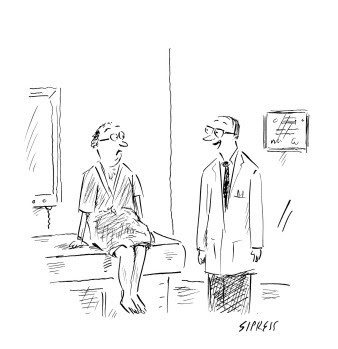
"I can cure your back problem, but there's a risk
you'll be left with nothing to talk about."
you'll be left with nothing to talk about."
Mobility is not the same as flexibility. Flexibility is the ability of muscles, ligaments, and tendons to passively stretch. Mobility is the joint's ability to actively move through its full range of motion. Good mobility requires flexibility in the muscles and other soft tissues surrounding the joint, but it also requires strength and stability. You can be flexible but lack mobility.
Recent studies have found a correlation between joint health
and longevity; also, that people with lower limb mobility are less likely to
suffer from falls in their older years. Here are some tests for checking your
mobility:


Here’s a link to exercises to improve your mobility. Here's one from an earlier blog of mine for improving your flexibility. Apologies
to those who have already seen this information in The New York Times.
For an introduction to this blog, see I Just Say No; for a list of blog topics, click the Topics tab.
I am in favor of guaranteed annual income—or universal basic income, or similar proposals. They’re a form of social security in which a population group receives a regular sum of money, either from a government or from some other public institution, independent of any other income. The idea, in the words of the Stanford Basic Income Lab and Center for Guaranteed Income Research, is to “…facilitate individuals' opportunity, freedom, and resilience to build financial security.” In the United States, about 30 pilot programs have been established and evaluated.
A large body of research has shown that people tend to use the money for essentials, such as rent, transportation and food—also for medical care. In one pilot program, 2800 participants received cash benefits via debit card of up to $400 per month for 9 months. As reported in The Journal of the American Medical Association, researchers found that—compared to a control group—the cash benefits significantly reduced emergency room visits. That’s because people spent money on healthcare—including visits to subspecialists—to forestall such visits.
In another pilot program, 3000 participants in Illinois and
Texas received $1,000 monthly for three years beginning in 2020—a 40 percent
boost in their incomes. At a time when even Americans with insurance say they
have trouble staying healthy because they struggle to afford care, the study results show
that basic-income recipients increased their spending on health care services,
including visits to hospitals and dentists. (Almost two in five insured
Americans report delaying or skipping necessary treatment or medication because
of high out-of-pocket costs for health care.)
Studies have not proven that the cash transfers have had a
lasting impact on the physical health of the recipients (probably too late). Even
so, recipients at least have more resources to seek help when they need it.
For an introduction to this blog, see I Just Say No; for a list of blog topics, click the Topics tab.
From what I’ve been reading lately, it appears that doctors are increasingly suffering from burnout. In the opinion of Dr. Eric Reinhart, a physician at Northwestern University, burnout is caused in large part by “…our dwindling faith in the systems for which we work.” Definitions of burnout have included emotional exhaustion in response to intensive work, becoming emotionally drained, detachment from and negative feelings toward people they are trying to help, and a sense of helplessness and loss of purpose.
Nearly two-thirds of physicians report that they are experiencing burnout, and are “…finding it difficult to quash the suspicion that our institutions, and much of our work inside them, primarily serve a moneymaking machine.” Examples include hospitals putting profits over people, the use of billing codes that dictate nearly every aspect of medical practice, and the profit motives of insurance and pharmaceutical companies that become intractable barriers to improving patients’ lives. A study of 10,000 family physicians showed that key contributors to burnout also include the need to spend time at home working on electronic health records as well as a lack of a fully staffed support team.
Now we have a chronic physician shortage. One in five doctors plans to stop practicing in the coming years. In 2021, about 117,000 physicians left the work force, while fewer than 40,000 joined it. According to projections published by the Association of American Medical Colleges, the United States will face a physician shortage of up to 86,000 physicians by 2036.
The United States is the only large high-income nation that
doesn’t provide universal health care to its citizens. Instead, it maintains a
lucrative system of for-profit medicine. Dr. Reinhart supports universal health
care. So does The American College of Physicians, which says, in its position
paper, that “…the United
States needs a healthcare system that provides care for everyone, either
through a universal health insurance system, such as the UK NHS, or through a
pluralistic system that involves the government and private organizations.” So let’s
do it!
For an introduction to this blog, see I Just Say No; for a list of blog topics, click the Topics tab.
